Key Takeaways
- Lead With the Client’s Problem: Telling a car dealership owner or a club promoter “I’m a voice actor” gives them nothing to act on. “I produce radio ads” describes a result they can picture, so they start talking about the empty club or the dealership phone that never rings.
- One Producer Covers the Whole Ad: Radio ad production means the copy, the voice, the music, and the mix, all handled by one person. The client skips the work of coordinating a writer, a studio, and an engineer, and gets a finished spot.
- Simple Answers Win the Conversation: Voiceover invites long debates about AI, auditions, and why you aren’t working for Tyler Perry. A one-line answer gets people to your service faster, and you can deliver an ad for radio, SiriusXM, Pandora, or Spotify within 24 hours.
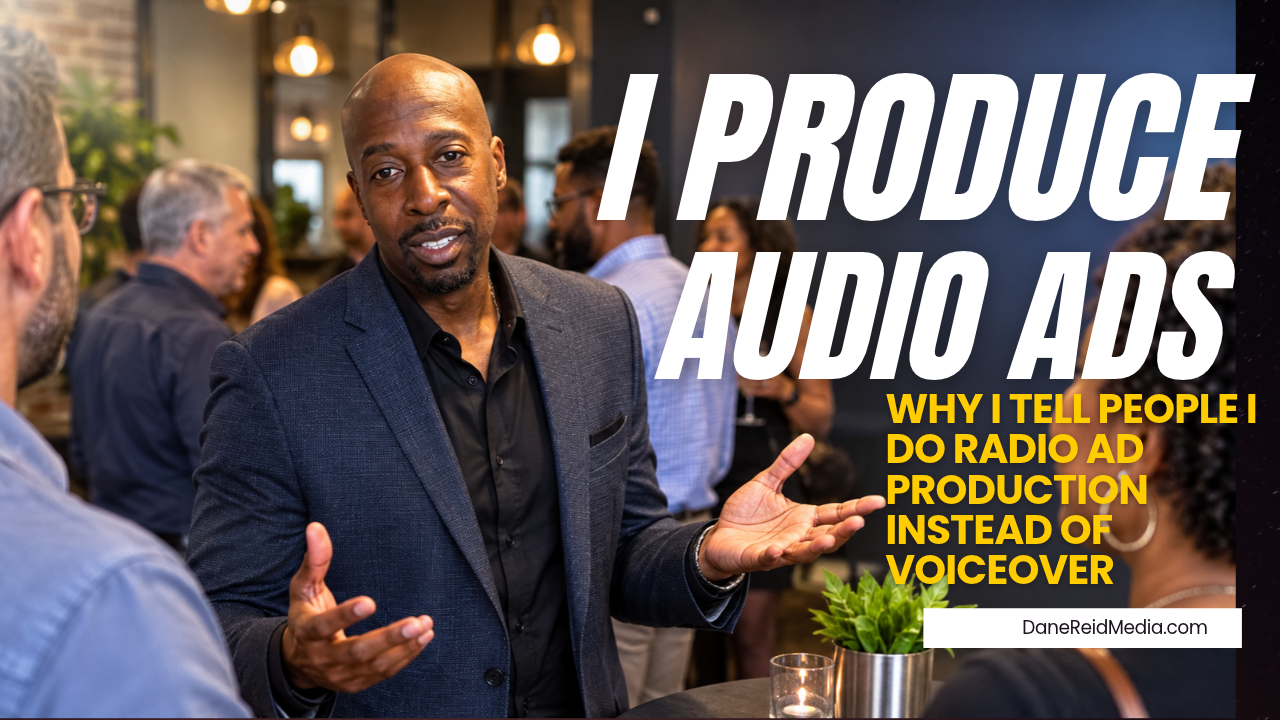
Explaining voiceover has never been easy for me. Plenty of people don’t realize it’s a career, and some of the people closest to me didn’t believe it until they watched me work. Voiceover has given me a great deal of joy, and I still stumble when someone asks what I do. Lately I’ve stopped explaining. I tell people I do radio ad production.
Why voice acting is hard to explain
The first question I got early in my career was why I wasn’t working for Tyler Perry or Disney. People assume the big jobs are one phone call away. The ones who understand auditions assume you audition and land the role, without picturing the 400, 500, or 1,000 other people reading for the same part. I book my fair share of voiceover work, and I strike out far more often than I land.
Two other conversations wear me down. Some people believe voice acting is just talking, and they tell me about the project they voiced ten years ago when someone liked their voice. And then there’s AI. People who understand voiceover ask what AI can do, and I end up in a long discussion about what it can’t do well. A stockbroker or a medical specialist has the same trouble explaining the small decisions that make up a day. People understand a job better in simple pieces, and “radio ad production” is one.
What radio ad production includes
A radio ad production client gets four things: the copy, the voice, the music, and the mix. I write the script, voice it, build the music around the read, and deliver a finished spot. The client doesn’t need to coordinate a writer, a studio, and an engineer.
Voice acting doesn’t solve a business owner’s problem
When I introduce myself as a voice actor to a car dealership owner or a club promoter, nothing in that sentence helps them. They have to work out what to do with me, and most of them decide I’m not useful to their business.
When I say I produce radio ads, the light bulb goes on. They tell me they’ve been wanting to run radio, or they’ve been running ads that don’t work — nobody’s coming to the club, nobody’s calling the dealership. That’s the problem I can solve. I’m the marketing agency, the copywriter, the producer and post guy, and the voice actor.
How my business works
Most of my career has been this work. I rarely audition as one voice among a thousand. I’ve networked and built my presence as an individual so that I’m the only voice actor in the room when a client is deciding. A client hires me because I solve their advertising problem, and the voice comes along with that.
Radio ad production vs. radio imaging
Radio ad production is work for advertisers. Imaging — the sweepers, promos, and station IDs that give a station its sound — is work for the stations themselves. I do both, and I use the two terms separately because the clients and the goals differ.
Get a radio ad produced in 24 hours
If you’re going to run radio, SiriusXM, Pandora, or Spotify, send me a message through my website. I’ll reach back out, and we’ll have an ad to you in 24 hours.