 Key Takeaways
-
-
The Audience Indifference: On platforms like TikTok and YouTube, millions of viewers consume AI-generated or AI-styled content daily without questioning or caring whether a machine or a human is behind the microphone.
-
The “AI Adam” Phenomenon: The massive online debate regarding whether viral creator Joshua Myers is a human using an AI style or a literal AI voice proves that authenticity has transitioned from an artistic standard into a separate form of passive entertainment.
-
The “Enshittification” of Voiceover: AI technology is quietly eroding professional voice acting careers by rewarding speed and low cost, conditioning audiences to accept lower artistic standards as “good enough” background noise.
-
The Normalization Effect: Over time, consistent exposure to rigid, robotic, and mispronounced automated scripts on social media desensitizes the public, turning what once sounded wrong into the baseline standard for digital content.
-
The Premium Human Market: Despite widespread automation on social video feeds, corporate clients and decision-makers are actively banning AI replicas in auditions, consciously reserving high-stakes projects exclusively for human emotion and precision.
-
I wrote an earlier version of this piece for VoiceoverXtra.com. That site has since closed after many years, so I’m reposting it here with a fresh set of eyes and a sharper question than the one I started with.
Why Every Voiceover Conversation Right Now Is About Artificial Intelligence
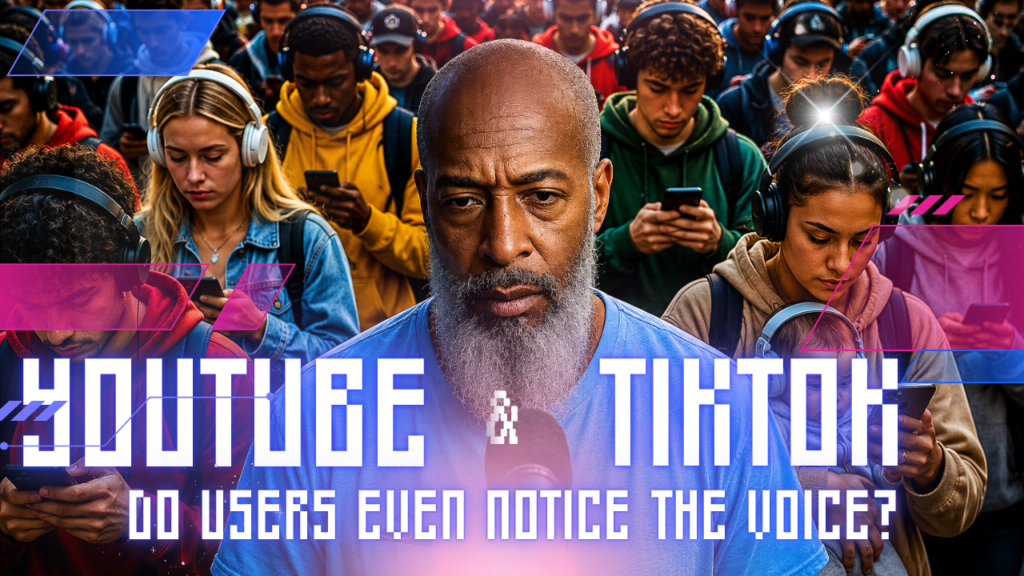
The conversation in the voiceover community right now is almost entirely about AI. Everywhere I turn, someone is asking whether this technology will replace us, whether our voices still have a place. I don’t consider myself an optimist or a pessimist about it. I’m someone who watches how things develop and tries to understand where they’re headed. And the question I keep landing on isn’t whether AI voices will exist. It’s whether the audience scrolling TikTok or watching YouTube even notices — or cares — when the voice they’re hearing isn’t human.
Using AI Tools While Defending Human Voice Acting Careers
Creative fields have always lived with uncertainty, but this moment feels different. Many of us defend our role as voice actors while using AI tools in our daily work. I use them to help write scripts and organize projects. I’ve used Suno to craft music for commercials. I’ve leaned on the same technology that we worry might one day make us optional. That tension sits at the center of everything we do right now.
What the Human Voice Actually Brings to a Voiceover Read
What gets said most often in the community is that AI does not have a soul. The human voice carries emotion and lived experience. When we read a line, we understand the context behind it. We feel the weight of the words and the moment they’re meant to serve.
I believe that. I’ve built my career on it. Voice acting, at its best, is timing, silence, breath, and meaning. It’s knowing when to hold back and when to push forward. It’s understanding a name, a culture, a story, and treating it with respect.
But sometimes I stop and ask a harder question. What if, for the audience, none of that matters as much as we think it does?
The AI Adam Phenomenon and What It Says About Audience Attention
If you spend any time on TikTok, you’ve heard the voice people call “AI Adam.” It’s everywhere — stitched into edits, reaction videos, comedy bits, brainrot content, you name it. The voice actor behind it, Joshua Myers, is genuinely talented, and there’s an ongoing debate online about whether the voice is actually AI-generated or a human doing an AI-styled impression. Videos titled things like “the real voice actor behind AI Adam” and “Joshua Myers finally admits” rack up millions of views, and the comment sections are full of people arguing over which it is.
That confusion is the actual story. An audience of millions has spent months consuming a voice without settling on whether a human or a machine is behind it, and it hasn’t stopped anyone from watching, sharing, or laughing along. Whatever the truth of that specific case, it tells me something about where the audience’s attention actually sits. They’re not listening for the quality of voice. They’re listening for something to chuckle at for the next three seconds of content. The debate over “real” has become its own form of entertainment, separate from whether the voice itself is any good.
How AI Voices Are Quietly Eroding Voiceover Careers and Artistic Standards
Set that specific example aside, because the pattern is bigger than any one voice or any one creator. AI voices, broadly, are already taking work that used to go to human voice actors, and they’re doing it at a pace the community hasn’t fully reckoned with. Every gig an AI-generated voice fills is a gig a working actor didn’t get. Every client who decides “good enough” is good enough is a client who stops considering what a real performance could have added. That’s what I mean when I say the technology is enshittifying voiceover as a craft. AI rewards speed and cost over expression, and audiences are increasingly conditioned not to notice — or mind — the difference.
What a Rotary Phone Taught Me About Audience Expectations
I’m a Gen Xer, and I grew up with a phone attached to the wall. It had a cord that stretched across the kitchen, and if someone picked up another line, you heard it. That phone was a staple in our house. It felt permanent. It was the first thing you saw when you walked in the front door.
If you’d shown me a smartphone back then, it would have felt like Marty McFly brought it back from the future. But no Delorian-driving teen made things suddenly change. Our rotary phone became a touch-tone. Call waiting came along when I was a teenager. A flip phone followed in my 20s, then a BlackBerry in my late 20s. Now my Galaxy Ultra Phone takes my travel photos, plays music on the plane, edits video, and connects me to friends around the world in seconds.
The old phone had character. The new one is a tool — replaceable, a commodity, and completely normal now. That’s the comparison I keep coming back to with AI voices. What feels strange and stiff today might become extinct tomorrow. The audience may not be looking for character. They may just be looking for content that’s fast and easy to consume.
I see it in my own life. My mother watches YouTube videos where the same rigid AI voice shows up over and over. It mispronounces words. It sounds robotic. It lacks rhythm and warmth. But there’s so much content like that now that she barely notices anymore. Over time, what once sounded wrong starts to sound normal. That’s what worries me — not that AI voices exist, but that they might become the standard. When that becomes the standard, it will lower the bar. The audience stops looking for good and starts looking for good enough.
The Voiceover Professionals Who Still Refuse to Compromise on Quality
There are people behind the scenes who still care deeply about quality voiceover. I regularly get audition breakdowns that explicitly state that auditioning talent may not use an AI replica of their own voice to submit — a rule that wouldn’t exist if the problem weren’t already widespread. And I still get messages through my contact form from clients who tell me, plainly, that they use AI for some projects but want a real human for this one. Those two things tell me the appreciation hasn’t disappeared. It’s just gotten harder to find, and it lives with the people making decisions rather than the people who are simply scrolling.
Why I Still Believe There’s Room for a Human Voice
I don’t know exactly where this leaves us as voiceover talent. It feels like an uphill battle at times, and I still question whether the audience on TikTok and YouTube cares, or even notices, most of the time. Maybe the answer isn’t to compete with AI on its terms. Maybe it’s to stand firmly in being as expressive as possible, and making the audience take notice.
Technology will keep moving forward. The question I keep asking myself isn’t whether the world will change. It’s whether there will always be space for a voice that’s not automated. That space may not be as loud as it once was, and it may not be as crowded. But I believe it’s still there, waiting for the people who can hear the difference. As a storyteller, I’ll keep fighting for it.