Last month I filled out the State of the Voiceover survey circulated by NAVA. It was my first time participating in the survey. It took me a few minutes of my time, but it was a month of waiting for the results. With the state of the world changing, I wondered how my beloved industry was weathering the storms of the world. Now, the news is out. While navigating the excitement of VO Atlanta’s arrival in the “A”, I took time out to drill into the numbers.
The 2026 voiceover survey data from the National Association of Voice Actors Foundation is the conscience of VO, and if you’re a voice actor, pay attention. Regardless of whether you are a veteran voiceover talent, a newcomer, or somewhere in the wide middle of this industry, these numbers paint a picture of our profession as things stand today. It’s an industry that is resilient, and for anyone concerned for their career in it, it’s worth understanding. I dug through all five sections of the survey so you don’t have to, and what I found is equal parts encouraging, sobering, and fascinating.
Where the 2026 Voiceover Survey Data Came From
Before diving into what the data reveals, it’s worth knowing exactly where it came from. The State of Voiceover in 2026 Survey was produced by the NAVA Foundation — a non-profit organization — entirely for educational purposes. To conduct the survey, NAVA didn’t collect any identifying information from voice actors. The survey opened up for entries from January 22 to February 22, 2026, and garnered 1,379 total responses. Responses came mostly from three sources: organic posts across Instagram, Facebook, and other social media platforms; voiceover-specific Facebook groups, including the NAVA members group, Voice Actors of NYC, The Gardner Collective, VO School Podcast, VO Mamas, Voiceover Pros, and more; and the NAVA contact list of approximately 4,000 voice actors and voiceover professionals. I received mine via email. I keep up with NAVA through their e-blasts.
The Voiceover Community Is Built by Experienced Professionals
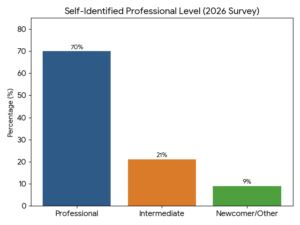 One of the first things I observed in this 2026 voiceover survey data is that the voiceover industry is full of experienced pros. The respondents are not a community of bright-eyed newbies who just bought a USB microphone. A significant portion of the voice actors who took this survey, like myself, have been working in voice over for years — many for over a decade. The largest demographic was professional voice talent who had been working for 15+ years. They represent 25% of the industry. When asked what level they would consider themselves, 21% identified as intermediate and 70% professional, which is telling. The people willing to answer a detailed industry survey tend to be those who have skin in the game.
What I find equally interesting is how voice-over fits into their lives. Voiceover has been my life for 21 years. It’s all that I do. But I’m not representative of the entire community. Some of us do it full-time, many do it part-time, and others treat it as a serious side job. The hours people pour into the craft every week — across sessions, auditioning, marketing, and business development — reflect the reality that voice over is mostly not a passive income stream, according to the survey. It is an active, demanding business. I have said that for years, and the data backs it up: this is a marathon, not a sprint.
The Home Studio Is Now the Standard
If you ever wondered whether voice over is truly a work-from-home profession, the survey settles it. Back when I started, I struggled to put together a great sounding home studio. In the beginning, I had to go into other studios just to audition. That has all changed. The overwhelming majority of respondents do their voice over work from their own home studio. In-person sessions at outside studios have become mostly rare. This is a change that has been building for years, accelerated by the pandemic, and now it is simply the new normal.
The rise of remote recording has democratized access to the industry in meaningful ways. You no longer need to be in Los Angeles or New York to compete for quality work. The survey also asked about Source-Connect, the industry-standard remote session software, and a notable segment of respondents maintains a paid version, signaling that professional remote connectivity is a real business investment. This, too, is a change from when I came into the voiceover business, when ISDN was the (very expensive) standard.
The 2026 Voiceover Survey Data on Income Tells a Complicated Story
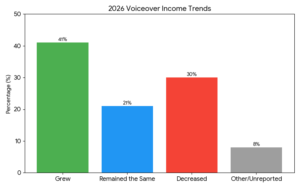 Here is where the 2026 voiceover survey data gets both complicated and a little uncomfortable. Money is always hard to talk about. The results were mixed. 41% of voice actors reported that their income grew. 21% said that their income remained the same. But 30% said their income decreased. Respondents were asked about their gross income from voice over in both 2024 and 2025, and whether that income grew, declined, or held steady. Income distribution was spread across a wide range, from those earning very modest amounts to a smaller group generating substantial six-figure revenue from voice over work alone. The industry has never been an even playing field, and the survey’s answers reflect that.
What stood out to me was the question about where income actually comes from. Agents, pay-to-play platforms, and direct marketing each represent distinct revenue streams, and no single source dominates across the board. Voices.com and Voice123 appeared as the most commonly used online casting sites. A large portion of respondents do some form of direct marketing, with many sending only a handful of outreach touches per day — a reminder that consistent, sustainable marketing beats sporadic bursts every time. The 2026 voiceover survey data makes it clear that the most successful voice over businesses are diversified ones.
Artificial Intelligence Is Already Inside the Industry
The AI section of the survey may be the most consequential for anyone thinking about the future of voice over. I have written about the implications of AI on the industry before, and it’s a topic that many voiceover talent are grappling with, trying to get ahead of. The 2026 voiceover survey data shows that 13% of respondents have willingly agreed to have a synthetic version of their voice created — for jobs, auditions, or personal exploration. Some of those synthetic voices generated income in 2025. At the same time, 9% voice actors reported that a synthetic version of their voice was used in a professional project without their knowledge, and 21% said they have knowingly lost a job to a synthetic voice.
The industry’s feelings about all of this are nuanced and, frankly, human. Survey comments reflected a range of attitudes: expecting fair compensation for synthetic voice use, wanting better safeguards and regulations, expressing cautious openness to AI while not fully trusting the industry around it, and acknowledging that AI-generated voices could serve people with disabilities. What the data does not show is a community that has simply rolled over. Voice actors are watching, advocating, and thinking hard about how to engage with AI on their own terms.
The Demographics of Voice Over in 2026
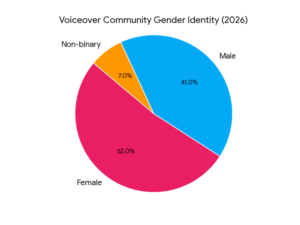 The demographic section of the 2026 voiceover survey reveals a community that skews toward adults in their thirties through fifties, with 27.5% representing the largest number, being between 41 and 50. There is a broad mix of gender identities represented, too. 52% are female. 41% are male, and 7% are non-binary. A portion of respondents, 15%, identified as disabled, and a subset noted that their disability directly affects their ability to perform voice over work. Racial diversity data was collected as well, continuing NAVA’s commitment to understanding representation within the industry. Of the respondents, 1065 identified as White, 155 as Hispanic or Latino, and 152 as Black Voice Actors. Other respondents were represented in significantly smaller numbers on the survey.
The fact that NAVA asks these questions at all is significant. Authentic casting, inclusion, and equitable access to the profession are not just talking points for the organization — they are embedded in how they measure the health of the community itself.
The Union Question Gets an Honest Answer
Perhaps the boldest section of the survey is Part Five, which asked SAG-AFTRA members whether they have ever broken Global Rule One — meaning whether they have ever done unsanctioned non-union work. The survey was completely anonymous, and 154 SAG-AFTRA members answered yes. That’s 65%. Their reasons were straightforward: more available and better-paying non-union work, limited union opportunities in foreign language voiceover or international markets, a feeling that SAG-AFTRA does not do enough to support voice actors, and a reluctance to damage long-standing relationships with non-union clients.
This is not a scandal — it is real people having to pay real bills. The data simply says what many in the community already knew was happening.
What The NAVA Voiceover Survey Means for Voice Actors
The 2026 voiceover survey is a mirror of the industry. It shows an industry populated by dedicated, experienced professionals who run real businesses, navigate real financial pressures, and face real challenges from AI and changing market dynamics. For voice actors early in their careers, the data is a road map for what to expect and what to build toward. For those of us who have been doing this for a while, it is a reminder that the fundamentals are still important. A voiceover business requires skill, business development, direct relationships with clients, and a long-term view of the career. The industry is changing. Having this data helps me evolve my business.