Key Takeaways
-
The Audio Deficit: Visuals alone cannot simulate reality. True immersion requires 3D soundscapes where audio remains pinned to an object or character, even when the player turns their head.
-
Curing VR Isolation: High-quality video game voice acting integrated with spatial audio tricks the brain into feeling a “presence” in the room, overcoming the loneliness of the virtual space.
-
The Indie Advantage: Indie developers don’t need massive budgets to beat the “uncanny valley.” By leveraging spatial audio, creators can organically guide player attention and build authentic environments (crucial for virtual travel and language learning).
-
The Future of EdTech & Travel: Combining 3D sound with history and language education turns static digital environments into living memories.
The Bottom Line: To build the future of VR, creators must design for the ear as much as the eye. Authenticity and human connection—explored deeply by creators like Danereidmedia.com—depend entirely on sound matching the quality of the sight.
Magic of the Virtual World and Why Sound Matters
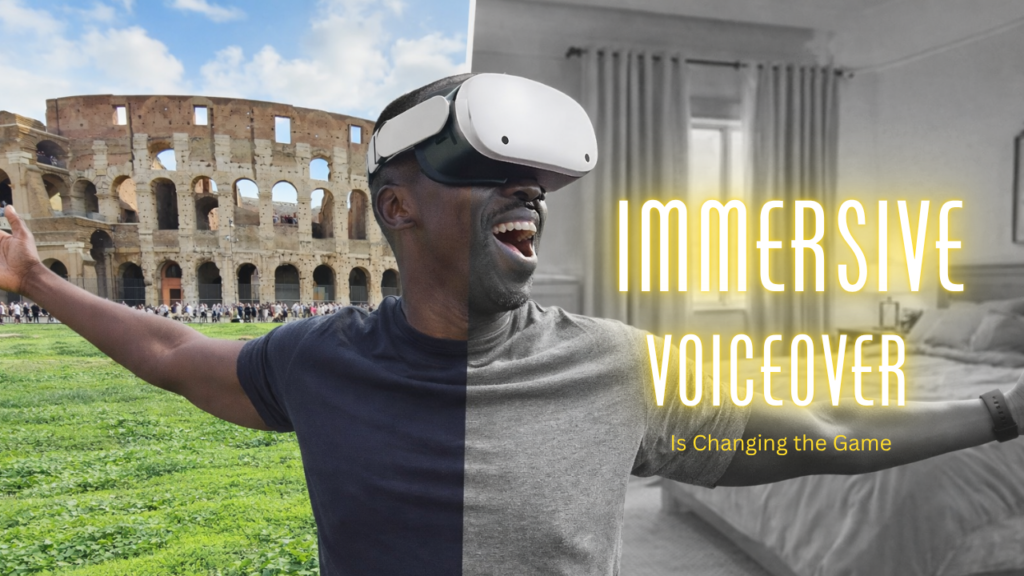
I still remember the day I got my Galaxy Gear VR headset. It was a game-changer. I snapped my Galaxy S8 phone into the front of that plastic visor, and suddenly my living room disappeared. One moment I was standing on my rug in Atlanta, and the next I was standing in the middle of Rome. As many of you know, I am a world traveler with a huge imagination. Being able to see the Colosseum years before I actually set foot in Italy was mind-blowing. When I finally did make it to Rome in real life, it felt unreal because I had already walked those streets in digital form.
My curious mind didn’t stop at geography. Strapping the Gear to my face, I used that headset to travel through time. I’ve always been fascinated by paleontology and the history of the world. I stood in the middle of the jungle watching dinosaurs roam, and the battlefields of World War II to see the history I had only read about in high school and college. I even visited the small town in Cuba where my grandmother was born. It was an emotional experience to see her roots through a lens. But even back then, I realized that looking at a world isn’t the same as being in it. The visuals were great, but something was missing to make it feel truly alive.
That missing piece is what we now call spatial audio for VR. Back then, the sound was often just flat stereo. It didn’t matter if a dinosaur was behind me or to my left because the sound just sat in my ears. Today, indie developers and VR creators are realizing that video game voice acting needs to exist in a 3D space. For someone like me who loves immersive storytelling, the sound is what actually anchors me to the environment. If I turn my head, the voice of a character should stay pinned to their body, not follow my ears. This is how the industry is moving from simple games to true experiences.
Overcoming the Isolation of the Headset
As much as I loved those early days of VR, there was a major downside. The headset was heavy, and being in that world felt incredibly lonely. I call it the isolation of the virtual space. I wanted to share these wonders with my friends and family, but they weren’t interested. While I am excited about technology, many of the people in my life are actually intimidated by it. They didn’t want to strap a computer to their face and disappear. This loneliness is one of the reasons many headsets ended up in the back of a closet collecting dust. Mine eventually joined them, especially after Samsung stopped supporting the Gear.
However, the industry has learned a lot since those early days. To fix that feeling of loneliness, creators are leaning heavily into immersive storytelling. When you have high-quality video game voice acting, it feels like there is another soul in the room with you. It breaks that wall of isolation. If a character whispers in your right ear and you can feel the directionality of that sound, it tricks your brain into feeling less alone. Spatial audio for VR is the bridge that connects a lonely player to a living world. It makes the digital characters feel like companions rather than just pixels on a screen.
I also thought VR would be my secret weapon for learning Spanish. At the time, I was dedicated to becoming fluent, and I read that immersion was the fastest way to learn. I imagined standing in a market in Mexico City, practicing my verbs with virtual locals. This is where the quality of the audio becomes vital. For a language learner, hearing the nuances of a native speaker through spatial audio for VR makes the practice feel real. You aren’t just listening to a tape; you are engaging in a space. This type of immersion is exactly what Danereidmedia.com explores when looking at how technology and human connection intersect.
How Indie Devs are Changing the Game
For the indie developers out there, the lesson is clear. You don’t need a massive budget to create a hit, but you do need to understand how humans perceive space. Immersive storytelling isn’t just about high-resolution textures. It is about how the world reacts to the player. When you invest in professional video game voice acting, you are investing in the emotional core of your project. If that voice isn’t integrated into a 3D soundscape, you are losing half of the impact. The goal is to make the player forget they are wearing a headset at all.
We saw the rise and fall of the metaverse hype, but the creators who stayed are the ones focusing on the details. They know that spatial audio for VR is what prevents the “uncanny valley” feeling, where things look almost real but feel wrong. By using sound to guide a player’s attention, you can tell a story that feels natural. If a bird chirps in a tree behind you and you instinctively turn around, the immersion is complete. That is the power of a well-designed 3D soundscape. It turns a static environment into a living memory.
As a traveler, I look for authentic experiences. Whether I am in a village in Indonesia or the Louvre in Paris, the sounds of the environment define the memory. The clinking of coffee cups or the distant sound of traffic tells me where I am. Video game voice acting should work the same way. It should compete with the ambient noise of the virtual world to create a sense of presence. When indie devs master this, they create experiences that people don’t want to put in the closet. They create worlds that people want to return to over and over again.
The Future of Immersive Storytelling
Looking back on my journey from the Galaxy Gear VR to where we are now, it is clear that the technology has matured. We are moving away from the novelty of just “seeing” things. Now we want to “experience” them. Immersive storytelling is the future of education and travel, and entertainment. Imagine a student today studying the history of the world not by looking at a map but by standing in a virtual forum where the echoes of ancient speeches bounce off the stone walls. This is only possible through advanced spatial audio for VR.
I still have a huge imagination, and I still believe in the power of these tools to change how we learn and grow. Even though my first headset is gone, the lessons I learned from it remain. We need technology that brings us together, or at least makes the digital world feel less empty. By focusing on quality video game voice acting and 3D sound, creators can build bridges for people like my family who are usually afraid of tech. If it feels natural enough, they won’t be intimidated anymore. They will just see it as another way to travel.
The work we do at Danereidmedia.com is all about these narratives. We want to tell stories that matter, and we want to use the best tools to do it. Whether it is through a blog post or a VR experience, the goal is always connection. As spatial audio for VR continues to improve, we will see a new era of creators who prioritize the ear as much as the eye. That is how we keep the headsets out of the closet and on our faces. We are building a world where you are never truly alone, even if you are just standing in your living room.
Building Better Worlds Through Sound
To wrap this up, we have to remember that the human element is what makes technology worth it. My grandmother’s hometown in Cuba wasn’t just a collection of buildings; it was a feeling. To recreate that feeling in a digital space, you need more than a 360-degree photo. You need the sound of the wind in the palm trees and the specific cadence of the local dialect. This is why video game voice acting is such a specialized craft. It requires an understanding of culture and emotion that a computer can’t just generate.
Indie creators have the freedom to be bold with these choices. They can experiment with how spatial audio for VR can lead a player through a narrative without using any on-screen icons. It is a more organic way to build a game. When the soundscape is right, the player becomes a part of the world rather than just an observer. This level of immersive storytelling is what will define the next decade of media. It is an exciting time to be a creator and an even more exciting time to be a traveler of both the real and virtual worlds.
I am still that person who wants to see every corner of the globe. While I prefer the real thing, I know that VR has a special place for those who can’t travel or for those who want to preview a destination. By focusing on spatial audio for VR, we make those previews more accurate and more moving. We make the history of the world accessible to everyone, regardless of where they are starting from. Let’s keep pushing the boundaries of what these virtual spaces can do by making them sound as beautiful as they look.